Design Philosophy
I am a junior interior design major at Washington State University. I have always been interested in design. I enjoy creating abstract and organized spaces. Figuring out corrections to problems through design is a process I believe is fundamental. When I design I want to meet the needs of a client in a creative way. I like to find multiple solutions to a problem to hear opinions to consider a different approach. I think design should have meaning, and that is what I strive to tell in my designs.
Monday, April 29, 2013
Little White Schoolhouse | Valley, WA
Sunday, March 31, 2013
IA Lecture Notes
Above are sketch notes I took at a lecture by Interior Architects. At this lecture the speaker stressed how important it is for the disciplines designing a building to interact as the design is happening. Not handing it off when your discipline is done with it. He said that this way of designing aids in efficiency and cost. I think that the integration at WSU between interior design, landscape architecture, construction management, and architecture is a step to toward what the professional field is like.
Monday, March 18, 2013
The Appaloosa Museum and Heritage Center was a good place to study for my studio project in Valley, Wa. I am designing a schoolhouse museum for their community to display the history of the town. This museum gave examples of what is useful in a museum and ways I can improve my design.
This wall was an inspiration to me because the community of Valley said they wanted a chronological sequence to their museum. This wall has a flow to it that would be beneficial to the design.
The Valley community will have items to display that shouldn't be touched. Display cases like these would make everything visible and protected. To combine interactive and enclosed displays breaks up the monotony of a museum.
This this a brick walkway that has names of donators. The community where my studio project is expressed they needed ways to fund the museum and this would be a way to do so.
The Valley community will have items to display that shouldn't be touched. Display cases like these would make everything visible and protected. To combine interactive and enclosed displays breaks up the monotony of a museum.
Tuesday, February 19, 2013
Webster Environmental and Earth Sciences & Physics Exhibit Design
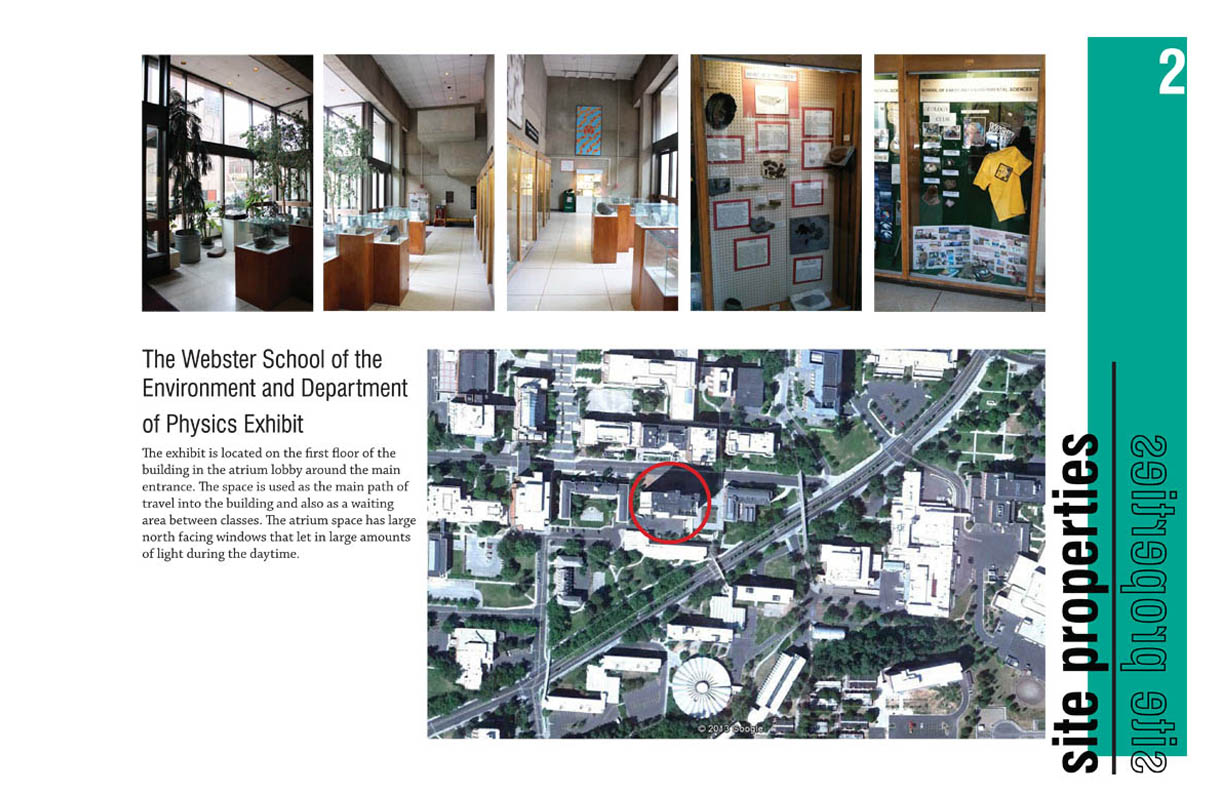
The geology-environmental sciences-physics exhibit in Webster Hall is on the Washington State University campus. This geology exhibit showcases seven display wall cases and eight moveable cases on the floor. The physics displays are six interactive exhibits. The flow of the space before was not conducing to bringing people into the exhibition space. This may be due to the out of date content being displayed. My team of nine and I brainstormed ways to bring the public into the exhibition space through design.
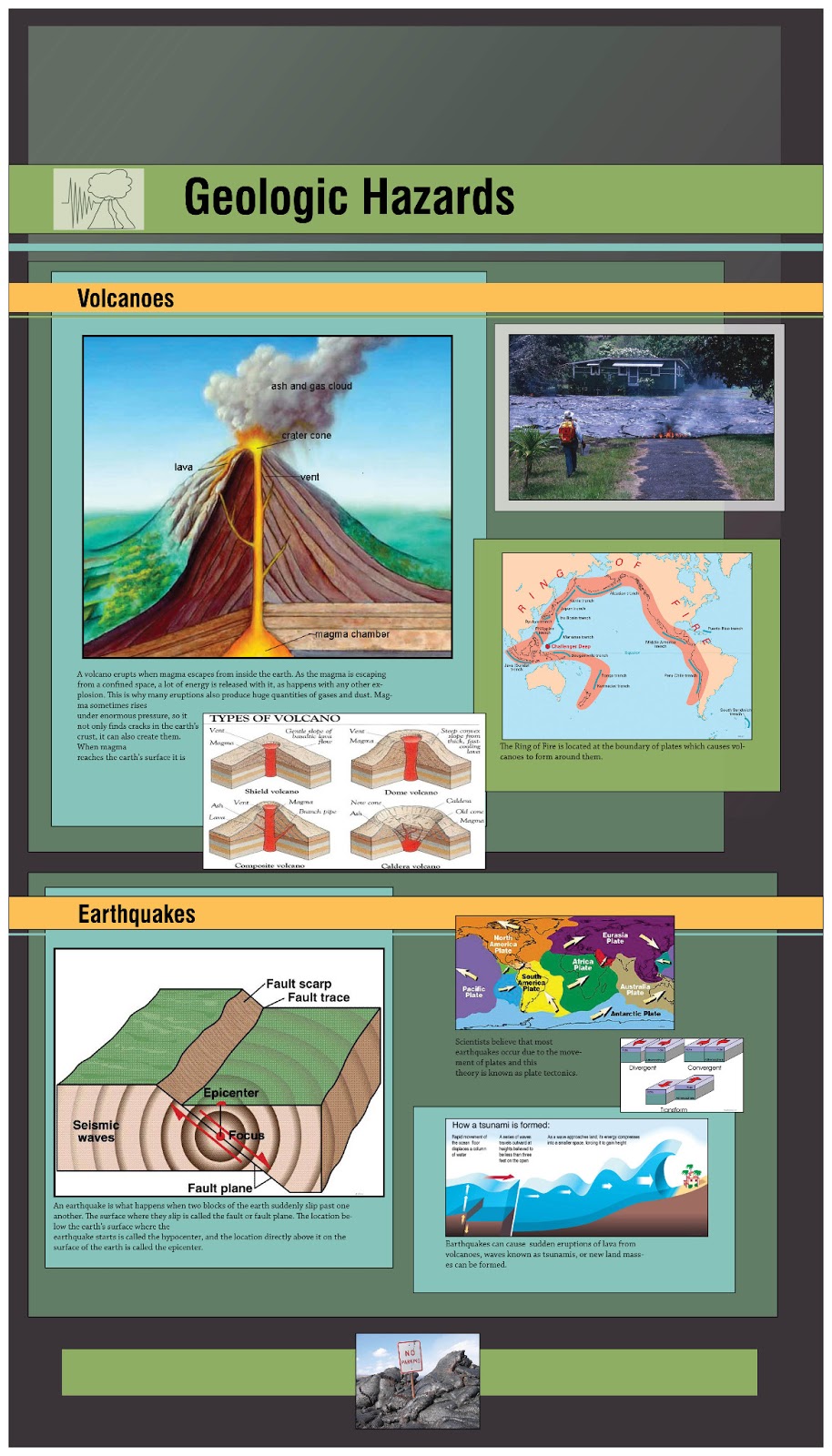
We started off by creating a chronological story in the seven geology wall displays. My team and I each researched a topic and then one team member created the graphic displays. I believe our displays are cohesive and create hierarchy, but seem to be on the dark side. That is not a bad thing though because of the strong daylight of the windows, this dark background will provide contrast.
To make the geology wall displays more interactive we added some hands on learning components. Such as this one with moving blocks to learn about the different boundary types. I know when I took the Geology 101 course I had trouble remembering the boundary types, I feel like a tactile model will be beneficial to learning.
The light study I did was at night to see how the electric lights were displaying the material. The lights were strongest in the wall display cases. During the day the daylighting was where the brightest light was at.
The circulation plan we developed is to create a crossing flow of people. They do not need to go straight back to the elevators, the open feel with the benches will bring people into the space. Because there are now benches centrally located this will attracted people to stay awhile and enjoy the exhibit. Through the development of the floor plan the circulation was thought of. I found circulation to be a large contributor in the placement of objects. I think I strengthen my reconfiguring skills during this project because the existing furniture and components all needed to stay in the space.
The physics interactives are interesting, but have out of date signage. It is long text that is written in a formal matter. We did not “dumb” the content down; we just reorganized it with the use of color to create hierarchy and attraction. I also helped with the graphic display and content of the program for this project. From this part of the project I strengthened my graphic design and my use of design language skills.
This project was done in a group of nine, which is one of the largest teams I’ve worked in. I enjoyed seeing the collaboration of group members on tasks, as well. We all had our partners within the group that we could work on our parts with. All nine of us checked in periodically to see how others were getting along with their parts.
I think this project helped me strengthen my organization skills and meeting deadlines. Working with a small budget was interesting to create simple solutions that will make a large impact in the space. Small changes can lead to the outcome that we want in the space which is for people to enjoy it and learn.
Credit: Kimberly Cox, Megan Pharmer
We started off by creating a chronological story in the seven geology wall displays. My team and I each researched a topic and then one team member created the graphic displays. I believe our displays are cohesive and create hierarchy, but seem to be on the dark side. That is not a bad thing though because of the strong daylight of the windows, this dark background will provide contrast.
Content Credit: Kimberly Cox, Megan Pharmer; Graphic Display: Elizabeth Jurgeleit
To make the geology wall displays more interactive we added some hands on learning components. Such as this one with moving blocks to learn about the different boundary types. I know when I took the Geology 101 course I had trouble remembering the boundary types, I feel like a tactile model will be beneficial to learning.
Credit: Megan Pharmer
The light study I did was at night to see how the electric lights were displaying the material. The lights were strongest in the wall display cases. During the day the daylighting was where the brightest light was at.
Day Study
Credit: Alicia Brandkamp, Taylor Brock
Night Study
Credit: Kimberly Cox, Megan Pharmer
The circulation plan we developed is to create a crossing flow of people. They do not need to go straight back to the elevators, the open feel with the benches will bring people into the space. Because there are now benches centrally located this will attracted people to stay awhile and enjoy the exhibit. Through the development of the floor plan the circulation was thought of. I found circulation to be a large contributor in the placement of objects. I think I strengthen my reconfiguring skills during this project because the existing furniture and components all needed to stay in the space.
Credit: Megan Pharmer
The physics interactives are interesting, but have out of date signage. It is long text that is written in a formal matter. We did not “dumb” the content down; we just reorganized it with the use of color to create hierarchy and attraction. I also helped with the graphic display and content of the program for this project. From this part of the project I strengthened my graphic design and my use of design language skills.
Credit: Marit Pinkoske, Megan Pharmer
This project was done in a group of nine, which is one of the largest teams I’ve worked in. I enjoyed seeing the collaboration of group members on tasks, as well. We all had our partners within the group that we could work on our parts with. All nine of us checked in periodically to see how others were getting along with their parts.
I think this project helped me strengthen my organization skills and meeting deadlines. Working with a small budget was interesting to create simple solutions that will make a large impact in the space. Small changes can lead to the outcome that we want in the space which is for people to enjoy it and learn.
Tuesday, May 1, 2012
Depot Final Project
These are my final boards for my depot project. The Northern Pacific Depot is a train depot in downtown Pullman, Wa that I did an adaptive reuse of. The depot will contain a residence, a studio, and a gallery for the artist. I completed 4 perspectives, one of the gallery lobby, gallery space, studio, and the great room of the residence. I chose materials for these spaces as well. I also completed elevations and sections throughout the depot. There are demolition and egress floor plans that I was new to. The furniture floor plan is also repeated in the final model. My process board shows a bit of the process throughout the project. I chose to use the bright yellow for the boards because it was the color I started with in my parti. I also applied my textile pattern to the background of my posters in gloss black. It does blend with the matte black background but adds to the presentation. From this project I learned more about technical drawings and codes that go along with them. I would say my concept was developed well through the process of finding an inspiration object and working with 2D and 3D abstractions to then develop into the depot design.
Depot Study Models
These are study models of my 3D development of my Depot design. I was able to plan floor plans in a way I could visualize. I also was able to think of ways to apply my concept to the project. This first model I made the residence on the far left too large, but I liked where the gallery and studio locations. For the second one I liked the radial symmetry of the gallery, but there were lots of tall windows on the exterior walls. This would not allow many paintings to hang on the walls. The third has the gallery on the far left and has walls on either exterior wall for easy viewing, but did not apply my concept very well. The fourth is pretty similar to the second model I just moved some of the central studio walls for different circulation. This fifth model is the most like my final floor plan. I used radial walls in the gallery that have different rotating positions. The "L" shape of the studio allows the residence and the studio entries to be on opposite walls for distinctive entries. I learned from this project to push for ideas that would not otherwise be tried because this was not meant to look perfect. It was meant to spark an idea that would not be explored on a 2D piece of paper.
Tuesday, April 17, 2012
Depot Concept Model
This is the parti I made from my door hardware inspiration. This parti employs emphasis, line, contrast, and balance. Emphasis is seen in the yellow line. Line is used in the straight and curved lines. Contrast between black and white and straight and curved lines. This parti has a symmetrical balance.
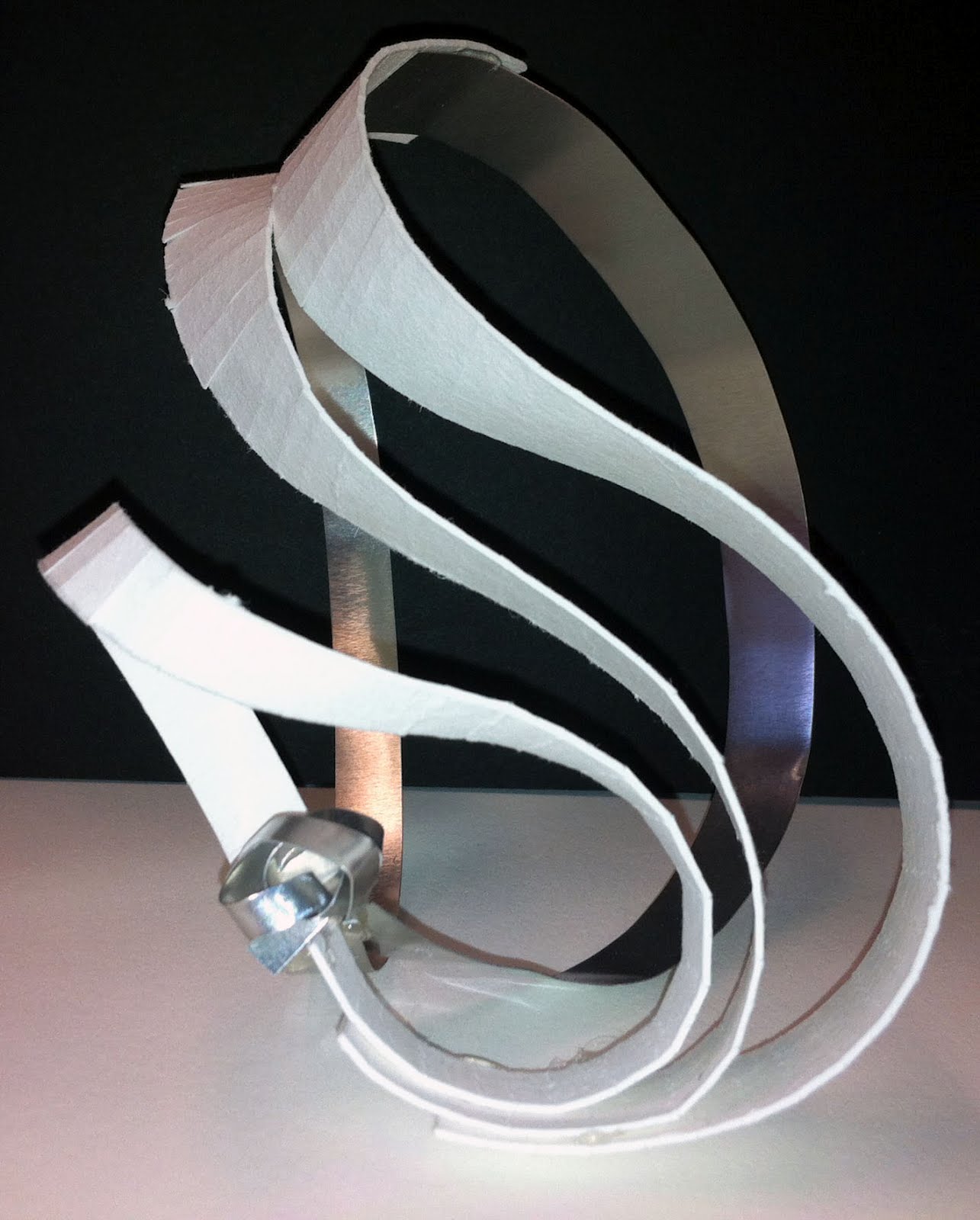
This is my concept model I used for inspiration for the depot design. I designed this concept model my starting with door hardware I saw at the depot and then developed a 2D parti. I took the elements and principles from the door hardware and the parti to create the concept model in 3D. The model has emphasis at the metal ball that radiates out to the lines and then connects back to the metal ball. There is a use of curved lines and contrast between the white and metal materials. The balance of this model is asymmetrical. I have done this process of working from 2D to 3D and I believe it helps with the design of the overall plan because it enables me to think abstractly before planning a space. The exploration to create an abstract object creates ideas to employ into the overall design.
Tuesday, April 3, 2012
2012 Acedemic Showcase
This is a sketch of the Implications for the Development of Interdisciplinary Foundation Course Pedagogy. The layout was easy to read and follow. I found it interesting that I was involved in this event this poster was based on. Interior Design, Architecture, and Landscape Architecture came together to create a bench design. All of the different disciplines come from different teaching backgrounds, so we all approached the concept in different ways. There was a found object that was to inspire the bench design. The Interior Design students were abstract and the Architecture students were literal was something that I noticed. This poster was acknowledging the preconceived notions of each student. Being able to work together early in education is a good idea to work towards so all disciples are well rounded and understanding.
This was the Kyra dress at the showcase made by Marsha Baerlocher. She is a fashion merchandising major at WSU. This dress was a sustainable dress that they will feature in their clubs fashion show. Her mother owns a winery and had lots of left over corks so Marsha put them to use in her dress. She sliced the corks in pieces and dyed some in wine for different colors. This applies to interior design on the aspect of sustainability. Using recyclable materials for different functions they were intended for is good to understand. Her idea could be applied to an interior surface such as a wall.
This dress is made out of unused/misprinted flyers for the Fashion Show. I thought this was a creative way to advertise for a fashion show because it is exactly what they do is design dresses. This caught my eye because they could have thrown away all of their flyers, but instead put them to use. They are going to be making another dress to advertise this years show, too. I almost think this is a better way to advertise because it would bring people close to read what it is saying. Instead of handing out flyers that will possibly not even be read an thrown away or littered. I enjoyed all the different posters at this showcase and learned many new things.
Wednesday, March 28, 2012
Textile Reflection Essay
The textile process began with an inspiration object that I analyzed for elements and principles. The door hardware that inspired me had balance, emphasis, line, and contrast. Next I created a parti which embodied these elements and principles. To begin the patterned I rotated the module/parti in many directions to form the textile pattern. I scaled the pattern to be smaller and larger than the original for comparison. I chose to print the larger pattern on my fabric for the textile. My textile is a bit more faded than I thought it was going to be, but the pattern printed well. The process of designing a textile is beneficial to a project to be able to understand the textile business. I do not think I will go with the colors I chose for this textile to be used in the overall design of the Depot project, but this color harmony would be beneficial in a different space.
Monday, March 26, 2012
Artist Client Brief
This is my client brief poster for the 1916-1917 Northern Pacific Depot in Pullman, Washington. The train depot will be an adaptive re-use containing a residence, artist studio, and artist gallery. Samuel Mirkovich is the artist who will be living in the residence with a visually impaired person. He will use the studio space to paint his contemporary impressionist pastel paintings. From this poster I furthered my knowledge of Photoshop through the background image. Research about the client is necessary to the design process because it is a part of the dialogue between the client and designer. For the design process to progress the communication should go back and forth for changes to be made at the appropriate time in the process.
Friday, March 2, 2012
Adaptive Re-Use Gallery
The information I gathered about this adaptive re-use gallery was relayed to my classmates, to gain more knowledge in adaptive re-use to put toward their train depot design. I chose the Dahmen Barn in UnionTown, Washington. This barn used to be an old dairy farm and was converted into a gallery, artist studios, and a gift shop. I had the chance to see this gallery and I think that it was a great use of the space. The barn is a place for the community to gather for different events that have to do with art. My partners on this project found two other adaptive re-use galleries and I found it interesting to compare what spaces were before they were galleries. Our poster design was cohesive to all of our galleries because our photos were to stand out like art in a gallery on a white back drop. We added gray lines to balance the color of the pictures on the left. We chose contrasting text such as the script and the all capitals title. I think this speaks art because art is never the same, it is always changing and different from the last.
Thursday, March 1, 2012
Vision Disablility Ability Workshop Reflection
The first experience I had with vision impairment was to look through a plastic bag (Ziploc). This represents 20/60 vision, one can still legally drive during the day. I hope glasses would make seeing better because I could see nothing clearly, just the outline of shapes. I assume this vision is worse at night time since driving is only legal during the day. When I think of that I think of how the lighting in the CUB, where the experience took place, and how they dim the lights. This hinders visitors with vision disabilities. I tried to read the newspaper and I had to get really close to read the large title, but I could not make out anything else. This was helpful when thinking about signage in a design, and that it should be large so the majority of people can see it.
Then the Ziploc bag was folded in half, which represents legally blind vision. I could see nothing, but lighting being bright. I would like there to be more lighting contrasts in design for people who are legally blind because it was something I could identify.
I looked through a vision simulator tool, which represented vision loss like tunnel vision, loss of center vision, cloudy vision, and blind vision. Each of these were different experiences and made me think of the ADA guidelines pertaining to vision. I could not see much in my peripherals which explains why walls should not have protrusions.
Next, I wore sunglasses with petroleum jelly smeared on them to simulate vision impairment. I walked into the Bookie to find the elevation to the first floor. If I would not have previously known where the elevator was I would not have been able to follow the signs that said where it was located. I am not even sure there were signs to the elevator. While waiting for the elevator I noticed the down button was lit up which made it easy to access. While in the elevator the buttons were not lit up but did have contrasting colors of white and black. I think lights would be more beneficial. The buttons also had braille, which I cannot read, but that makes the keys understandable for someone who can read braille. I then went to the ATM machine on the first floor of the CUB and I noticed the card slot was lit up. But the keys for the pin were not and had a cover to block others vision from pin number input. This cover is not helpful because it blocks the light to the keys. There was a nub on the five key and I think that is universal to the five because it is always the center number. The enter and cancel buttons had an "o" and an "x". these were raised like the five nub. I was not sure what they were till I peeked out of the glasses though. This first floor ATM contrasts to the second floor ATM because the second floor has more vision and hearing cues. The second floor ATM had a light for the card slot, the keys were not blocked by the pin hiding lid, there was braille on all items of the machine, there was a head phone jack so someone who cannot see can hear what the machine is saying on the parts they cannot read. I then went to the Holland-Terrel Library to walk down the atrium stairs. These stairs were made of white terrazzo and had a black grip to contrast in texture and color. The atrium also provides lots of natural light which made the contrast even greater. These stairs contrast greatly with the ones in the CUB. The CUB has green and black terrazzo stairs with a black grip. The grip itself provides texture difference, but it visually blends into the terrazzo color. Plus the CUB stairwell is not lit brightly so the dark stair color and lighting do not make these stairs visually friendly.
I believe that the built environment should be accessible to any/everyone. If we design for the average that does not include everyone and that is not right. Just because some have disabilities does not mean they should not be thought about in design. Design qualities that are meant to be benefited by people with disabilities actually are beneficial for everyone.
Then the Ziploc bag was folded in half, which represents legally blind vision. I could see nothing, but lighting being bright. I would like there to be more lighting contrasts in design for people who are legally blind because it was something I could identify.
I looked through a vision simulator tool, which represented vision loss like tunnel vision, loss of center vision, cloudy vision, and blind vision. Each of these were different experiences and made me think of the ADA guidelines pertaining to vision. I could not see much in my peripherals which explains why walls should not have protrusions.
Next, I wore sunglasses with petroleum jelly smeared on them to simulate vision impairment. I walked into the Bookie to find the elevation to the first floor. If I would not have previously known where the elevator was I would not have been able to follow the signs that said where it was located. I am not even sure there were signs to the elevator. While waiting for the elevator I noticed the down button was lit up which made it easy to access. While in the elevator the buttons were not lit up but did have contrasting colors of white and black. I think lights would be more beneficial. The buttons also had braille, which I cannot read, but that makes the keys understandable for someone who can read braille. I then went to the ATM machine on the first floor of the CUB and I noticed the card slot was lit up. But the keys for the pin were not and had a cover to block others vision from pin number input. This cover is not helpful because it blocks the light to the keys. There was a nub on the five key and I think that is universal to the five because it is always the center number. The enter and cancel buttons had an "o" and an "x". these were raised like the five nub. I was not sure what they were till I peeked out of the glasses though. This first floor ATM contrasts to the second floor ATM because the second floor has more vision and hearing cues. The second floor ATM had a light for the card slot, the keys were not blocked by the pin hiding lid, there was braille on all items of the machine, there was a head phone jack so someone who cannot see can hear what the machine is saying on the parts they cannot read. I then went to the Holland-Terrel Library to walk down the atrium stairs. These stairs were made of white terrazzo and had a black grip to contrast in texture and color. The atrium also provides lots of natural light which made the contrast even greater. These stairs contrast greatly with the ones in the CUB. The CUB has green and black terrazzo stairs with a black grip. The grip itself provides texture difference, but it visually blends into the terrazzo color. Plus the CUB stairwell is not lit brightly so the dark stair color and lighting do not make these stairs visually friendly.
I believe that the built environment should be accessible to any/everyone. If we design for the average that does not include everyone and that is not right. Just because some have disabilities does not mean they should not be thought about in design. Design qualities that are meant to be benefited by people with disabilities actually are beneficial for everyone.
Subscribe to:
Posts (Atom)